Natural ventilation may sound like an unconventional, sustainability-driven idea to some. However, it was the energy-friendly status quo up through the middle of the last century, back when “green buildings” referred to paint color. If you consider traditionally favorable conditions, several design considerations, and control options, you may recognize a future project where natural ventilation is an idea whose time has come again.
Design engineers are under a lot of pressure these days to reduce energy consumption in buildings. Consequently, natural ventilation is a good concept to explore as fans and cooling systems can eat up a significant portion of the energy budget for many facility types. This article is aimed at providing a conceptual understanding of how to approach natural ventilation design for occupied facilities where mechanical ventilation might normally be employed to provide comfort. Without fans, there are two driving mechanisms for the movement of air: wind and buoyancy. Actually, wind, like buoyancy, is largely the consequence of thermal forces acting out on the surface of the earth, whereas when we speak of buoyancy in natural ventilation, we are looking at the thermal forces developed inside of and at the surface of our building envelope.

FIGURE 1. Atrium using stack effect to drive natural ventilation.
Natural Ventilation Concepts
A good place to start is to determine whether wind or buoyancy will be the dominant factor in driving the natural ventilation process. This will intuitively follow from the building layout and key architectural elements such as a centrally located atrium or courtyard. A multi-story building with an atrium located in a mild climate would be a good candidate for using the stack effect to promote natural ventilation as shown in Figure 1.As atria are usually heavily glazed to permit interior daylighting and to create a pleasing aesthetic, they can also act as solar chimneys, thereby aiding thermal driving forces. This scenario must be coordinated and integrated into the life safety system, since a smoke control scheme may need to be employed. It may be possible to use smoke control fans in a limited manner to augment the natural ventilation system during periods of insufficient wind and thermal buoyancy in a mixed-mode type of system. Such fans could also be beneficial in a strategy known as night-time ventilation, where cool air is brought in after hours to flush the building of warmer air and to sub-cool the interior mass of the building in anticipation of the next day’s activity.

FIGURE 2. Single-sided, single opening ventilation.
When wind is the chosen mechanism, there are several strategies that can be used to successfully capture this resource to ventilate a building. The simplest is the single-sided, single opening where wind turbulence drives the ventilation. This strategy results in lower ventilation rates and less air penetration distance. A rule of thumb is to keep the depth of the room to twice the floor to ceiling height or less as shown in Figure 2. By placing two openings at the perimeter, one high and one low, the depth of the room can be increased to 2.5 times the floor-to-ceiling height since there is now some stack effect to help the ventilation process as indicated in Figure 3. Oftentimes, the lower opening is placed behind a radiator or other perimeter heating element to eliminate cold drafts in the winter.
By having a narrow floor plate, which can be accomplished with a courtyard, cross ventilation can be set up as shown in Figure 4. This approach will also enhance the daylighting potential of the building. As air moves across the space towards the leeward side of the room, it will be warmer and carry more contamination. Therefore, with cross ventilation the rule of thumb is to limit the room width to five times the floor-to-ceiling height.
Design Considerations
Since the cooling capacity of a natural ventilation system is obviously limited, the design team must work to reduce both solar and internal gains to the building. Although this should be the aim of any high-performance building project, it deserves to be repeated here. Ideally, the space cooling loads from all sources should be limited to about 12 Btuh/sq ft, which translates to about 1,000 sq ft/ton of traditional mechanical cooling. As you can see, attempting to limit space temperatures below the American custom of 75°F with this cooling density constraint would be difficult (or perhaps impossible) to achieve in most climates.
FIGURE 3. Single-sided, double opening ventilation.
Due to the free movement of air through the building envelope, natural ventilation provides a direct path for ambient noise sources such as road traffic to disrupt occupant activities. Another issue is the potential for the introduction of pollutants to the building. Additionally, certain U.S. government entities require adherence to Anti-Terrorism Force Protection (ATFP) standards, which would make natural ventilation problematic to execute in many instances. These issues as well as climate considerations make mixed-mode ventilation a consideration for some facilities. Mixed-mode is a concept where natural ventilation is combined with mechanical ventilation to accommodate the varied needs of a facility.
Mixed-mode systems come in different varieties. One version is where parts of a facility are designed strictly for natural ventilation and others for mechanical cooling with occupancy or access to windows being the differentiating factor. An example of this would be a building with office and conference areas that are mechanically cooled and an adjacent work space that relies on natural ventilation. This approach has worked well in the K-12 educational sector with naturally ventilated classrooms and mechanically cooled office areas that are typically occupied in the hot summer months. Another concept utilizes a changeover sequence where a building relies on natural ventilation when outdoor temperatures are favorable and then switches to mechanical ventilation during extremes in weather. Since occupant expectations weigh heavy on a design engineer’s mind, mixed-mode ventilation can provide peace of mind when planning a natural ventilation project.
When it comes to calculations for natural ventilation, nothing beats the power of computational fluid dynamics (CFD). Although many design firms cannot justify the costs of such software or the expertise to operate it, there are some good guidelines and simple formulae available that can be employed for many cases and applications. The best resource may be the CISBE applications manual,AM10 Natural Ventilation in Non-Domestic BuildingsandAM13 Mixed Mode Ventilation.
Control of Natural Ventilation
An important aspect to consider when developing the control strategies for natural ventilation is the differing design parameters between summer and winter operation. Summer airflow requirements will be higher than for winter, dictating less opening area in the building envelope between the extremes of the seasons. Compounding this is the increased stack effect in the winter due to indoor and outdoor temperature differences.Control for natural ventilation can either be manual, automatic, or a combination of the two. For simple systems such as ones using the single-sided approach, manual control may suffice. Colored indicator lights can be added to alert occupants for times when outdoor temperatures are optimum for opening windows. A good strategy is to automate windows located up high, such as clerestories, and have the lower windows manually controlled. Indicator lights and window automation can be linked to interior temperature sensors and an exterior weather station. Sensors on the façade can also be used to generate inputs to the control system for wind speed and direction.
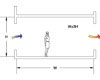
FIGURE 4. Cross ventilation.
In addition to controlling openings such as windows and roof vents, roller blinds and other sun-shading devices can be integrated into the overall environmental control system. It is important to consider certain automated control schemes when employing a mixed-mode system, such as turning off cooling systems, or closing cooling coil valves when windows are open or when the dewpoint is elevated.
Commissioning is an essential element to the successful of operation of any building, and it cannot be stressed enough that the introduction of natural ventilation compounds the importance of this process. It is recommended that the commissioning agent be brought on board early in the design process and that the contract be extended into the post-occupancy period so that crucial adjustments and fine-tuning can be made.