- Too warm
- Too cool
- Too drafty
- Too stuffy
- Too noisy, too quiet
- Too expensive
- Too complicated
Rather than play the blame game, here we will note what can be done to remedy the problems for those who suffer from the conditions.
Setting The Room Temperature
The thermostat or sensor that controls a room or zone temperature condition should be set at a setting that is good for most occupants. Today’s workforce is a mixture of genders and age groups. ASHRAE has recognized these differences and has created comfort zone tables (Figure 1). Consider selecting a setting of 74°F to avoid having to change the settings between summer/winter seasons as well as to create a good setpoint for office occupants. The designer should also be aware that the thermostats have a 1° to 1.5° dead band on either side of the setpoint, which broadens the band of comfort. Summer cooling will dehumidify to 50% rh, and humidity may be added in the winter to bring the rh up to at least 25% to avoid a “too dry” complaint.Too Warm
This condition is often caused by a lack of cooling. A design problem may be insufficient cfm being provided on the morning sun side of a building and the starting schedule for turning on the HVAC system. The sun rises at 5 a.m.; however, the HVAC system does not start until 7 a.m. This time lag allows a heat gain build up from two hours of sun heat gain. When the cooling system does start, it does not have enough capacity to handle the excess heat that was not taken into account in the design program. The space eventually reaches a comfort stage, but it is often after lunch.The solutions are for the designer to provide more cfm capacity for morning “pick up” or to have the system operator start the HVAC system sooner in the summer months. The building operator should remember that this morning heat gain is a positive addition in the winter heating months.
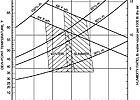
Figure
1. Acceptable ranges of operative temperatures and
humidity. (Table courtesy of ASHRAE.)
Too Cool
Absence of heat in the occupied zone results in cold temperatures. Heating from an overhead source must deliver the warm comfort air to the occupants. A winter heating “cool” condition is caused by setting supply air terminal units (VAV boxes) to have a minimum airflow. This airflow setting may be called the heating minimum or the ventilation minimum. At this low-flow condition, the cfm supplied to the diffuser is not subjected to the induction principle of the diffuser. The result is that the heated air (hydronic or electric) leaves the diffuser at the low flow and simply rises to the ceiling. Current DDC operation of the VAV boxes allows the cooling airflow to reduce to the heating (ventilation) minimum, turn on the heat, and then return to increased flow rates. Diffusers with neck sizes over 12-in. in diameter, when used in offices spaces with 9-ft ceilings, tend to dump the cold air due to not being able to mix the delivered air with the room air. An option is to use slot diffusers with their small necks and high induction features. A good rule of thumb for traditional diffuser (vaned, perforated, plaque) neck sizes (in in.) is to relate the neck diameter to the ceiling height (in ft). For example, use an 8-in. diffuser neck in spaces with 8-ft ceilings and a 10-in. diffuser neck in spaces with 10-ft ceilings.Too Drafty
Air distribution HVAC systems have the options to diffuse, blow, or throw the air into the occupied zone. A diffuser location too close to a wall or ceiling obstruction will divert the diffuser flow and will cause it to flow downward, thus resulting in a draft situation. Sidewall grilles or registers blow a stream of cool air into the space. If the occupant is in the landing area of the airstream, a draft complaint can result.Airflow nozzles are selected when long airflow distances are required. This system is mainly used in large high-ceiling spaces like atriums and multistory lobbies, thus the draft complaints only occur when a person passes through the airstream. A solution to these types of air distribution problems is to arrange the throw drop zone to avoid a person’s workstation position. The throw velocity in the occupant zone should be about 100 fpm to avoid a draft complaint. Still air is noted to be at 50 fpm for a point of no draft reference.
These types of systems are also used in gathering spaces such as churches and theaters. In such situations, the solution is to slightly warm up the blown or thrown air to about 60° to 65° to avoid a cool draft. This conditioned air should fall through the rising thermal plume from the occupants and then the mixed air should be returned low. The unit supply air is dehumidified in the summer to the 55° coil discharge and then warmed up for space delivery.
Too Stuffy
This complaint is caused by a reduction in air being supplied to a space. Pinch-down VAV terminals close down when the cooling load is reduced, resulting in a lack of ventilation air. This is often a winter complaint, but it can also occur in the summer. A simple solution is to raise the main supply unit’s discharge temperature to 60° to 63°. This will allow the VAV unit to supply more air to the space. When the ventilation component is gone from the office or conference room, a stuffy atmosphere occurs.Another typical conference room problem is lack of a return air path from the room. The architect would require that all the walls be built to the deck for sound containment and that the mechanical system would not have a return air transfer duct across the walls. The result is that since no air can flow in or out of the space, the temperature rises and there is no air movement.
Too Noisy (Too Quiet)
Most noise complaints are airflow noise rather than equipment noise. Airflow noise is caused by air flowing at too great a velocity through the ductwork or VAV terminal or outlet devices such as diffusers, grilles, or registers. Be aware that when a client moves from a noisy office space into a new space they want a no-noise system. The designer must remind him that some noise is good for background noise masking.However, with under floor air distribution (UFAD) systems, the air is supplied at low pressure and low velocity. Under these conditions there is none of the usual background noise, and a white noise system must be included in the design.
Unwanted duct noise comes from conditions that cause turbulence in the airflow. Sources include elbows too close to VAV box inlets, duct dampers with space filling baffles when the damper is smaller than the duct, bull-nose tees used in the airflow path, and too many turning vanes in elbows close to the supply source. Provide branch duct dampers rather than diffuser neck dampers for balancing to avoid velocity noise from the diffuser.
Another condition is relative to selecting large VAV boxes (over 12-in. inlets) with systems that also have 6-in. and 8-in. inlet units. The larger units require more main duct static pressure to obtain the planned cfm capacity. The TAB contractor will raise the duct static pressure and then the smaller units’ damper closes down, thus causing velocity unit noise in the smaller layouts. These small layouts are usually serving one- or two-person offices where high noise levels are annoying.
Too Expensive
Every project has a budget, and the design team must work together from the beginning to stay the course of the cost range. All the traditional value engineering systems should be reviewed at the start of a project. The decisions to accept or reject the possible choices should be documented for the team. This documenting action will provide the rationale when the topic of “I can save you money” comes up at the time of bidding.Too Complicated
The operation of the HVAC system should not be above the ability of the operational staff. System operational training must be included when the type of system is new to the operations staff. Changing from a constant volume system to a variable airflow-type that requires knowledge of variable-speed controls is not an easy educational transition. Variable flow and heat recovery systems also require operator education.Other Too's
Microwaves and other sources often introduce break-room odors into offices with a resulting complaint of the space being “too smelly.” The design should contain a local exhaust to control these cooking odors. The added exhaust is considered part of the exhaust required for outdoor air ventilation systems. The designer must remember that in order for the ventilation to be provided, there must be a removal path (exhaust).Outdoor air intake louvers near the loading dock also create a smelly condition. A common example: delivery trucks do not shut their engines down, and thus the exhaust fumes are drawn into the air delivery system.
Oversized DX refrigeration systems result in a space being “too muggy.” The system may have been sized for a potential future load of more equipment or more staff. The HVAC unit is operated from a space thermostat. During the occupied day cycle, the fan runs continually to circulate the air and to provide outdoor air. The cooling compressor only responds to the cooling load and will not restart for a time period to avoid equipment short-cycling. Meanwhile, the warm moist outdoor air is being introduced into the building. The result is that the delivery air is not being dehumidified and feels muggy. A solution is to operate the cooling system and provide reheat from the condenser heat, recovered heat, or a hydronic system.
Conclusions
The HVAC systems in use today incorporate dedicated outdoor air delivery with a higher delivery temperature. The other portion of the air system deals with the sensible cooling loads. UFAD systems are also very popular. The designers must remember that diffusers need cfm’s to induce room air. A basic principle is that warm air rises and cool air falls. The cool air from UFAD must have force or velocity to deliver it into the occupant zone. This force is either from a fan or static pressure through the floor outlet.Heating from a VAV system requires the cfm to be high enough to be in the induction capacity of the diffuser. The system designer should pretend to be the system operator on the phone with the “too’s” complaints and plan ahead to avoid having to respond to these complaints.
Comfort conditions are achieved through maintaining a relationship between HVAC unit discharge temperatures, space thermostatic (sensor) setpoints, and terminal out selection. Careful selection of these relationships will minimize occupant complaints.ES